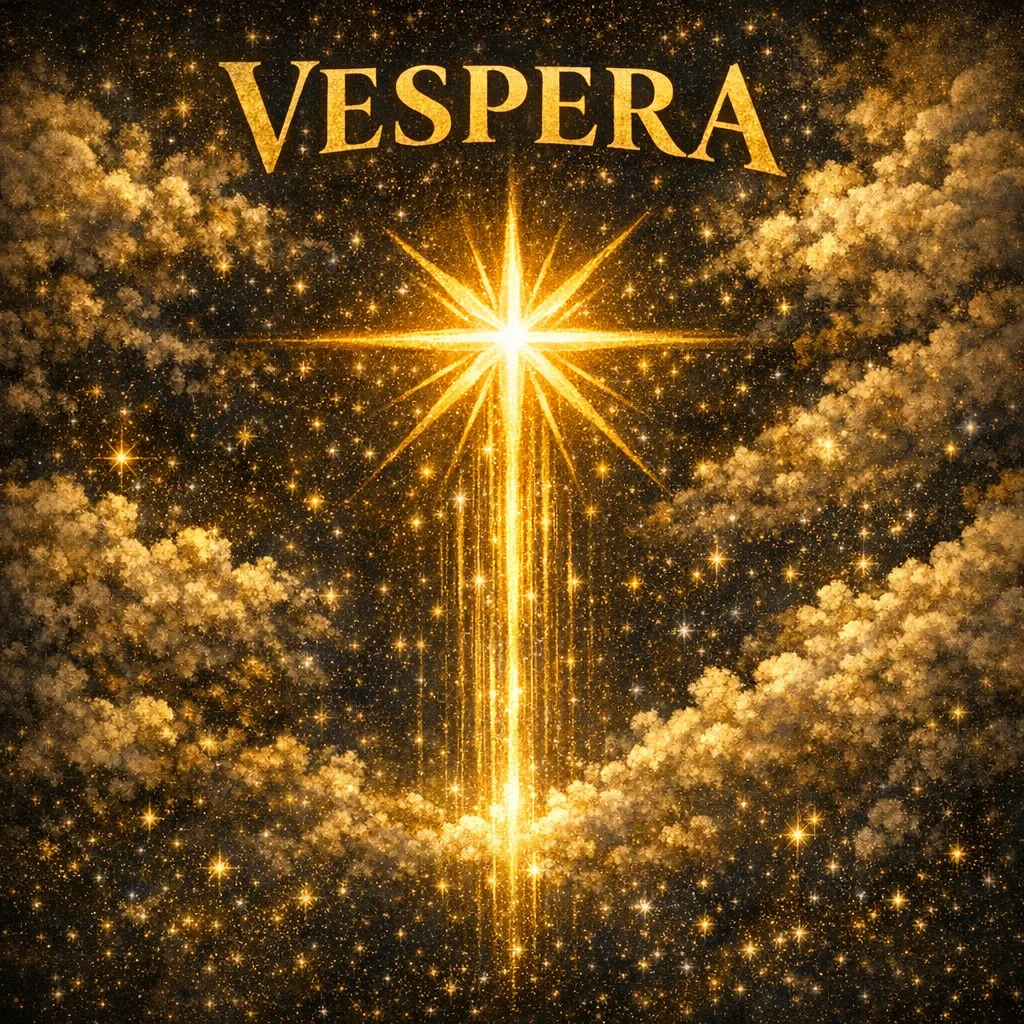
Album 05 · Stella Polare
VESPERA
Emotions Beneath the Veil of Centuries.
The album
VESPERA
Perhaps the most atypical album in the Stella Polare universe, somewhere between the sacred and the profane.
A timeless, almost suspended world, where personal emotions hide behind an ancient language.
The lyrics are first written in French and then fully translated into Latin.
A mysterious, almost secret language, allowing deeply intimate things to be expressed while keeping them at a distance.
Yet behind these ancient words lie very real emotions:
desire, doubt, longing, wounds, moments of wonder.
Latin becomes a veil, a form of protection.
A way of saying without revealing everything, and of giving these emotions a more universal dimension.
Musically, Vespera draws from Baroque and classical music, with influences from opera, ancient music and, at times, the liturgical tradition.
The head voices, soaring vocal lines and harmonies give the songs a theatrical, airy quality.
Then electronic touches break through this ancient world, creating a tension between two eras.
Like music that has travelled through the centuries to meet the present.
Latin thus detaches emotions from their time and context.
It is no longer simply about understanding the words, but about feeling their emotional weight, musicality and mystery.
You don’t always understand the words.
But you can understand what they make you feel.
Visual identity
VESPERA
It extends the album’s dialogue between the ancient and the contemporary, the sacred and the profane.
The aesthetic draws from the visual language of Baroque and classical art:
dramatic compositions, sculptural forms, rich textures, deep shadows and a sense of theatricality.
Rather than recreating the past, the imagery reinterprets it through a contemporary lens.
Ancient forms are fragmented, transformed and brought to life through light and movement.
The shapes appear to sparkle from within, surrounded by clouds of stardust.
They seem almost incandescent, glowing, burning, suspended between matter and light.
Yet the more they shimmer, the more they seem to disintegrate into dust, as if their own brilliance were slowly consuming them.
This tension between creation and disappearance, radiance and decay becomes an essential part of the visual language.
The textures evoke aged materials, stone, marble and metallic surfaces, but are constantly interrupted by particles of light, glittering dust and luminous fragments.
The result is both ancient and otherworldly:
something that could belong to a forgotten artwork, a celestial relic or a memory slowly dissolving before our eyes.
As in the music, the visual identity lives in the tension between two worlds.
Ancient and contemporary.Sacred and profane.Fire and dust.Light and disappearance.
A visual universe suspended somewhere between ritual, matter and starlight.
The tracks of this album will land here soon.
Next destination